
Finding the Answer to the Water Crisis in the Clouds

Opdateret: 10. jul.
FEATURE: In Bolivia’s cloud forests, fog is becoming an unexpected source of drinking water for communities facing increasing water scarcity
High on the eastern slopes of the Andes Mountains of South America lies the Yungas Ecoregion - a unique transition zone between the Andean highlands and the Amazon rainforest. Throughout much of the year, moisture from the Amazon rises along the mountain slopes, creating the clouds and fog that characterize the region’s forests.
Yet despite being surrounded by clouds, many communities are facing growing water shortages.
Families depend on springs, streams, local water systems and seasonal rainfall, but these sources are becoming less reliable as climate change and ecosystem degradation place increasing pressure on the region’s water cycle. The apparent contradiction raises an important question: if the landscape is surrounded by moisture, could some of that water be captured and used?
From Fog to Fresh Water
One solution attracting increasing attention is fog harvesting.
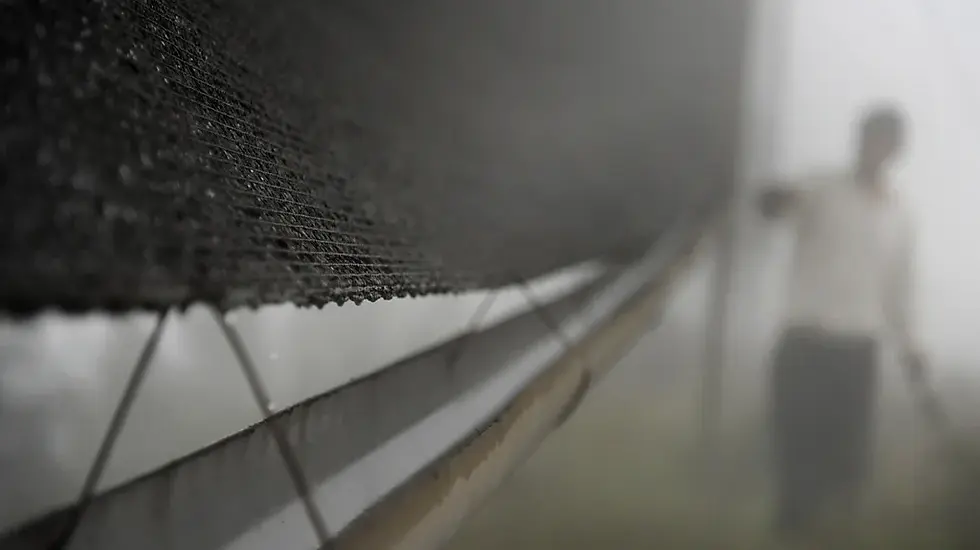
The technology is surprisingly simple. Large fine-mesh nets are installed in locations where fog frequently moves through the landscape. As tiny droplets pass through the mesh, they condense on the surface and gradually form larger droplets. These droplets are then collected through gutters and directed into storage tanks, where the water can contribute to local drinking water supplies.
Fog harvesting has been tested in mountain regions around the world and has demonstrated its potential as an additional water source in areas where conventional water supplies are under pressure. The pilot in Santa Teresa is among the first efforts to test the approach under the ecological and climatic conditions of the Bolivian Yungas.

From Theory to Practice in Bolivia
Fog harvesting was explored through a climate adaptation initiative led by Aktion Amazonas together with its partner Conservación Amazónica - ACEAA in Bolivia.
The initiative aimed to strengthen climate resilience in vulnerable communities across the Yungas region through improved water management, ecosystem restoration and community-led adaptation measures.
In the municipality of Apolo, following an environmental approval process, a pilot community drinking water system based on fog harvesting was established in the community of Santa Teresa. The system captures moisture directly from passing fog and channels the collected water through storage tanks and a distribution network serving local households.
The idea is that fog harvesting can complement traditional water sources and strengthen local water security during periods of scarcity. While the technology itself is relatively simple, it forms part of a broader effort to strengthen long-term water security and climate resilience in 24 vulnerable communities across Peru and Bolivia.
Across the project area approximately 6,000 people benefited from improved water security, ecosystem restoration and strengthened resilience to climate change.
The experience generated in Santa Teresa now provides a practical example of how fog harvesting can be integrated into community-led water management in mountain and cloud forest landscapes.
Part of a Larger Water Cycle
Fog harvesting is not being pursued as a stand-alone solution. Instead, it forms part of a broader approach that combines water harvesting, ecosystem conservation and community water management.
This broader perspective is particularly important in the Yungas. Acting as a hydrological bridge between the Andes and the Amazon, its forests help capture, store and regulate water across one of the world’s most important ecological systems.
Trees, mosses and other vegetation intercept moisture from clouds and fog and gradually release it into soils, springs and streams, helping maintain water availability throughout the landscape.
As Rozana Copa, Project Coordinator at ACEAA, explains:
“The cloud forest plays a crucial role in the water cycle. The leaves and mosses of trees collect moisture directly from the clouds and gradually release it into soils and watercourses. When forests disappear through deforestation, this natural water harvest disappears as well, further worsening water scarcity and increasing the need for forest protection and restoration.”
Local Knowledge Creates Lasting Water Security
Experience from across the Andes highlights that technology alone is rarely enough to solve water challenges.
Successful water solutions depend on local ownership, knowledge and long-term community engagement:
“Projects in the Andean region show that water solutions work best when they are developed together with local communities. Fog harvesting relies on local knowledge of wind directions, fog patterns and landscape dynamics, and the systems therefore require local organisation and maintenance to function over the long term,” says Rozana Copa.
As climate change continues to affect both the Andes and the Amazon, solutions that strengthen resilience across this interconnected landscape will become increasingly important.
Fog harvesting offers one example of how nature-based and community-led solutions can help communities adapt to a changing climate while strengthening water security for the future.
The experience from Santa Teresa will provide practical lessons that can inform similar initiatives in cloud forest communities across the wider Yungas region.

Kommentarer